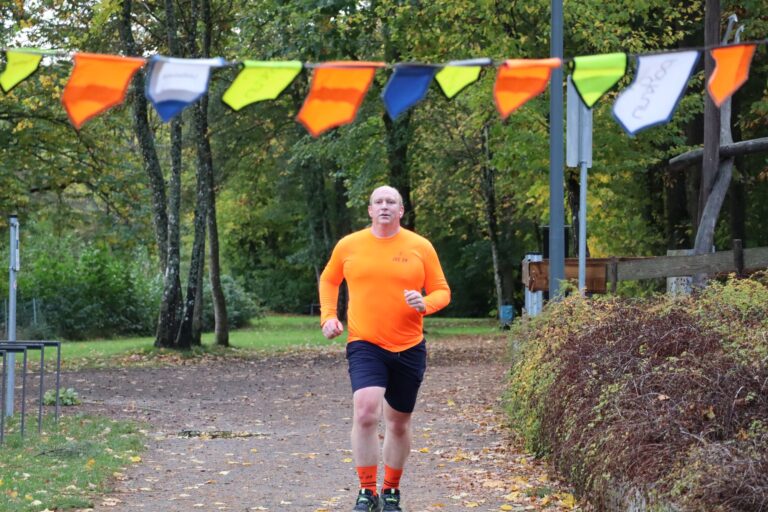

Saturday Morning Track Run
Following on from my last post about numbers, Saturday morning gave me a fairly good example of why I find them so useful. This time, the number in my head was 40 minutes.
After the calf injury I’ve been carrying and gradually recovering from, I wasn’t setting out to chase anything heroic. The objective was quite simple: get myself onto a running track, run continuously for around 40 minutes and keep my heart rate somewhere sensible and sustainable. If that happened to produce a 5km somewhere around the 40-minute mark, I’d have been delighted.
Strava, however, had other ideas. Its predicted 5km time was 38:09, which I looked at with a fair degree of scepticism. It seemed ambitious. My running had been interrupted by injury, I’m still carrying considerably more weight than I ultimately want to, and I hadn’t gone into the session intending to test myself over 5km. Still, one of the useful things about numbers is that sometimes they provide a target, sometimes they provide reassurance, and occasionally they suggest that perhaps you’re capable of a little more than you think.
Two Targets, One Track
My daughter came with me and had a very different target of her own: a sub-25-minute 5km. She’d actually tried it a couple of months earlier with my brother pacing her. The run itself had gone almost perfectly to plan, but she was using a different running watch at the time and the GPS had recorded the distance short. She’d effectively done the work, but didn’t get the clean 5km result to show for it, so understandably she wanted another go.
We had a bit of a drive to get to the track, which gave my brain far too much opportunity to do what it has always done when there’s a target involved: start playing with numbers. I worked out her target pace, my target pace, lap times, the difference between us and then, naturally, the really important calculation: how many times was she going to lap me?
My answer was five. If we both started together and both hit roughly the performances we were aiming for, I reckoned I’d see her come past me five times before I finished. Completely unnecessary information, but obviously I calculated it anyway.
Finding the Rhythm
I settled into the run fairly quickly. There’s something I notice both when running laps and when swimming lengths. The first quarter always seems to take forever. You’re aware of every lap, aware of how many are left, and probably doing far too much mental arithmetic. Then somewhere in the middle, something changes. The laps almost disappear.
I either get lost in thought or don’t really think about much at all. You settle into the rhythm and the repeated movement takes over, and before you know it you’ve covered far more distance than you realised. Then the final quarter arrives and suddenly you become aware of everything again: how far is left, how am I feeling, what’s the pace, can I maintain it?
That’s pretty much how Saturday went. The important part was that I felt comfortable. I was running continuously, my heart rate was where I wanted it to be and, crucially, my calf wasn’t complaining. But there was something else happening too: I was moving quicker than I’d expected.
Because I was running faster than the pace I’d calculated in the car, my daughter didn’t lap me five times. She lapped me four.
Eventually, as I came around the track again, I saw her stopped ahead of me and down on one knee. Naturally, the first thing was to check that she was alright. She was. She’d finished. She looked at her watch and saw 24:29.
She’d absolutely smashed it.
A properly recorded, unequivocal, sub-25-minute 5km. She was over the moon with herself and quite rightly so. She’d trained for it, wanted it, gone after it and delivered. There’s something particularly good about watching somebody achieve a target when you know what it means to them.
Then there was the slightly amusing contrast in our mornings. Her work was done. Mine wasn’t.
So off I went for another lap.
After that lap, she joined me again for my final two and a half. Having just run a 24:29 5km, she apparently still had enough spare capacity to spend most of those laps talking to me. I was somewhat less conversational, but it was a brilliant way to finish.
We had started the session together with two completely different objectives. She was chasing a hard performance target. I was trying to prove to myself that I could run continuously again without aggravating an injury. Both mattered. Both were personal. And we both achieved something.
My Fastest 5km in Two and a Half Years
For me, it turned into my fastest 5km in two and a half years, 35:59.
That alone would have made me happy, but the time was only part of it. I had run continuously, I had run faster than I thought I could, my calf appeared completely unaffected by the effort, and I finished absolutely elated by the performance. Given where I’ve been recently, that meant considerably more than simply seeing a quicker number appear on Strava.
The irony wasn’t lost on me. I’d gone into the session looking at Strava’s 38:09 prediction and thinking it wasn’t realistic, yet once I started running, the gap between what the algorithm thought I might be capable of and what I thought I was capable of suddenly didn’t seem quite so enormous.
That’s another useful reminder about data. Sometimes we look at a number and use it to limit ourselves. Sometimes the number is trying to tell us the opposite.
My body had already been giving the platforms information from the cycling, gym work, previous runs and all the other training I’ve been putting together. Strava had interpreted that information and come up with its prediction. I hadn’t quite caught up with it mentally.
That may be one of the more interesting parts of rebuilding fitness. Improvements don’t always arrive with an announcement. Sometimes the work has already started changing you before your own perception has caught up.
What Saturday Taught Me
My first takeaway from Saturday was simple: don’t underestimate yourself. That doesn’t mean setting completely unrealistic goals or ignoring what your body is telling you. My calf injury is exactly why I went into this run with a controlled objective rather than trying to smash myself around a track. But there’s a difference between being sensible and automatically assuming you can’t do something.
The second is to keep your head in whatever it is you’re trying to achieve. Progress has rarely come from one spectacular session for me. It has come from turning up again and again. The gym sessions, bike rides, controlled running, food choices, recovery and all the less exciting pieces eventually accumulate. You don’t necessarily notice the change while it’s happening, then one Saturday morning you run your quickest 5km in two and a half years.
And finally, if you have the opportunity, share the journey with somebody else.
My daughter and I weren’t competing with each other on Saturday. There would have been little point because we were running towards completely different targets. But we could celebrate each other’s success. When she stopped, I got to see her reaction to breaking 25 minutes. When I still had laps left, she came back onto the track and finished them with me.
And when things don’t go quite so well, those same people are there for that too.
That’s becoming an increasingly important part of Shift-Spark for me. The numbers matter. The targets matter. The improvement matters. But sharing those moments with the people around me makes the numbers mean considerably more.
Saturday gave us two very different 5km runs. One was 24:29 and a target emphatically achieved. The other was my fastest in two and a half years, completed after weeks of cautiously rebuilding from injury.
Both were worth celebrating.
And apparently my pre-run maths was wrong. I’ve never been happier to miscalculate the number of times I was going to be lapped.